Why Cast Iron is the Ultimate Choice for Camping and Open-Flame Cooking: A Scientific Breakdown
When you are miles away from a modern kitchen, standing over a crackling campfire, your choice of tools can mean the difference between a gourmet outdoor meal and a burnt disaster. For seasoned campers, there is only one choice: cast iron cookware.
But why? Is it just tradition, or is there a physical reason why cast iron products outperform stainless steel, aluminum, and titanium in the wild? Today, we analyze the thermal physics and material science behind the world’s most rugged cooking material.
High Thermal Mass: The Battery of the Kitchen
In outdoor cooking, heat is unpredictable. A gust of wind or a shifting log can cause the temperature of your flame to fluctuate wildly.
The Principle: Cast iron has a very high volumetric heat capacity. This means it acts like a “thermal battery.” Once it absorbs heat, it stores it and releases it slowly and steadily.
Why it matters for camping: When you place a cold steak on a thin aluminum pan over a fire, the pan’s temperature drops instantly. When you use a cast iron skillet, the pan’s massive heat reserve maintains the sear regardless of the wind or flame height.
Emissivity: Cooking with Infrared Radiation
Most people think cooking is just about the food touching the hot metal (conduction). However, cast iron cookware excels at radiant heat.
The Principle: Cast iron has high emissivity. It doesn’t just heat what it touches; it radiates heat energy deep into the food.
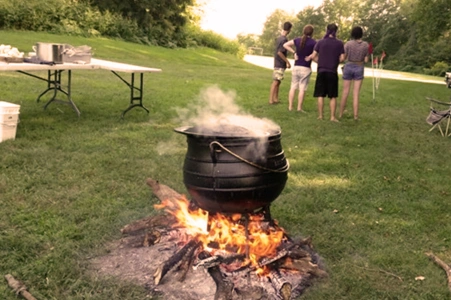
Open-Flame Benefit: This is why a cast iron Dutch oven is so effective at baking bread or slow-cooking stews over coals. The pot creates an “oven effect,” radiating heat from all sides, even if the flame is only at the bottom.
Durability vs. Thermal Shock
Campfires can reach temperatures exceeding 600°C (1112°F). Many modern non-stick pans will warp or release toxic fumes at these temperatures.
The Principle: Cast iron products are made of a robust alloy of iron, carbon, and silicon. It can withstand extreme heat without losing its structural integrity.
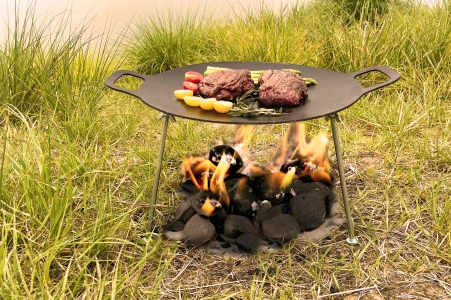
Survival in the Wild: You can place a cast iron griddle directly onto glowing red coals. While you should avoid throwing a hot pan into a freezing river (which can cause a crack), cast iron is generally the only material that can handle the “abuse” of a high-intensity open flame year after year.
The Self-Healing Surface: Polymerization in the Wild
Cleaning dishes in the woods is difficult. You don’t want to carry delicate detergents or scrubbers.
The Principle: The “seasoning” on a cast iron pan is a layer of polymerized oil.
The Camping Edge: Every time you cook bacon or fry potatoes in your cast iron skillet over the fire, you are actually maintaining the pan. The high heat of the campfire promotes further polymerization. Unlike a non-stick pan that degrades over time, your cast iron cookware actually gets better with every camping trip.
Versatility: One Tool to Rule the Campsite
In the backcountry, weight matters—but so does utility. A single cast iron pot can perform the duties of five different pieces of equipment.
| Method | Cast Iron Use Case |
| Baking | Use a lid and coals to bake biscuits or cobbler. |
| Frying | Deep fry fish or sear steaks with high-heat stability. |
| Stewing | Hang a cast iron pot over a tripod for all-day cooking. |
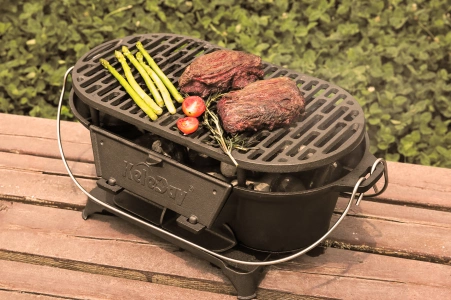
| Grilling | Use a cast iron griddle over the campfire grate for smash burgers. |
Conclusion
Cast iron cookware is not popular for camping just because it looks “cool” in photos. It is popular because it solves the two biggest problems of outdoor cooking: heat instability and equipment durability.
If you are planning your next expedition, a high-quality cast iron skillet from a trusted source like chinacastiron.com is an investment that will outlast your tent, your boots, and perhaps even your vehicle.
References & Technical Sources
Thermal Physics of Cooking: Heat Transfer in Traditional Cookware, International Journal of Gastronomy and Food Science.
Metallurgical Stability: Behavior of Ferrous Alloys Under Open Flame Conditions, China Cast Iron Research Portal.
Material Science: Emissivity and Radiant Heat in Cast Iron vs. Stainless Steel, Journal of Applied Physics.
Outdoor Survival Gear: The History and Utility of the Dutch Oven in Expeditionary Cooking, National Park Service Archives.
Polymerization Chemistry: The Role of High Temperatures in Fatty Acid Polymerization, American Oil Chemists’ Society.