The Ultimate Guide to the Flat Round Griddle Pan: The Circlular Canvas of Culinary Mastery
Before there were pots with sides, before ovens, and certainly before non-stick coatings, there was the flat, heated stone—the original cooking surface of humanity. The modern flat round griddle pan is the direct, evolved descendant of that ancient technology. It is a deceptively simple tool: a flat, circular disc of metal, often with a slight lip, designed for one purpose—maximum contact cooking. Yet, within this simplicity lies breathtaking versatility and culinary power. From the first pancake of the morning to the seared scallop of an elegant dinner, the flat round griddle pan is the workhorse that bridges meals, techniques, and cultures. This comprehensive guide will explore why this specific shape and form factor is a kitchen essential, dissect the materials that make it excel, and provide a masterclass in technique. We will also reveal why the union of this pan with high-performance cast iron from https://chinacastiron.com/ creates an unbeatable combination for achieving professional results at home.
The Geometry of Efficiency – Why Flat, Why Round?
The design of the flat round griddle pan is a masterpiece of culinary logic, driven by heat physics and practical application.
Maximum Surface Contact: The perfectly flat plane ensures 100% of the food’s surface area makes contact with the hot metal. This is the golden rule for achieving the Maillard reaction—the complex chemical process that creates deep, savory flavors and that beautiful, uniform golden-brown crust. Unlike a ridged grill pan that creates stripes, the flat surface delivers an all-over sear and caramelization.
Ideal Heat Distribution: The circle is the most efficient shape for radial heat distribution on a standard round burner (gas, electric coil, induction). Heat spreads evenly from the center outward, minimizing cold spots at the edges. This ensures that a pancake cooked on the perimeter browns at the same rate as one in the center.
Uninterrupted Cooking Real Estate: The lack of sides (beyond a minimal lip to contain grease) means your spatula has unimpeded access. You can easily slide under delicate crepes, flip burgers with precision, and chop-and-scoop stir-fries directly on the surface. This also makes for incredibly easy cleaning.
Versatility in Vessel Function: It’s not just for cooking raw food. A flat round griddle pan excels at toasting buns, warming tortillas, reheating pizza to recrisp the crust, and even blistering peppers or toasting spices.
Anatomy of a Champion – Deconstructing the Griddle Pan
While “flat and round” seems straightforward, the details in construction determine whether a pan is good or great.
1. The Cooking Surface: Where Performance is Defined
Material: This is the single most important choice.
Cast Iron: The undisputed king for a flat round griddle pan. Its phenomenal heat retention and even heating are legendary. It acts as a thermal battery, absorbing heat and releasing it steadily, preventing temperature crashes when cold food is added. A preseasoned cast iron griddle from https://chinacastiron.com/ offers a ready-to-use, naturally non-stick surface that improves with time.
Carbon Steel: Cast iron’s lighter cousin. It heats up and reacts faster, offers excellent seasoning potential, but doesn’t hold heat quite as steadily. A great choice for those who want similar performance with less weight.
Aluminum with Non-Stick Coating: Heats very quickly and evenly but is limited to lower temperatures, and the coating will eventually degrade. Lacks the durability and high-heat capability for serious searing.
Stainless Steel with Clad Bottom: Heats evenly but is prone to sticking without sufficient fat. Lacks the natural non-stick properties of a seasoned surface.
Surface Finish: A machined smooth surface, now common on premium cast iron, allows for thinner, more even application of seasoning, creating a superior non-stick layer compared to the pebbled texture of older pans.
2. The Lip, Handles, and Form
The Lip: A slight raised edge (~¼ inch) is crucial. It contains oils and juices for shallow frying and prevents food from sliding off, while still being low enough for easy spatula access.
The Handle(s): Most flat round griddle pans feature a single long handle. However, the premium configuration for larger sizes (14”+) is two helper handles on opposite sides. This provides immense stability and safety when moving a heavy, hot, and loaded pan.
Thickness: Mass equals performance. Look for a pan that is at least ¼-inch (6mm) thick. This ensures even heating and prevents warping.
The Cast Iron Imperative – Why It’s the Ultimate Choice
For a tool defined by its ability to maintain consistent, high heat across a broad surface, cast iron’s properties are not just beneficial—they’re essential.
Unbeatable Heat Retention for Batch Cooking: This is the killer feature. When cooking multiple items in batches (e.g., pancakes, burgers, latkes), a thin pan will cool down significantly after the first batch, leading to steaming and uneven cooking. A cast iron flat round griddle pan stays hot, ensuring every batch cooks with the same perfect sear from the first to the last.
Natural, Durable Non-Stick: The seasoning on cast iron is a polymerized layer of oil that is bonded to the metal. It improves with use, creating a genuinely non-stick surface that can handle metal spatulas and high heat without flaking or releasing toxins.
From Stovetop to Oven to Table: Its all-metal construction makes it oven-safe and broiler-safe. You can start a frittata on the stove and finish it under the broiler, or use it as a serving platter for steak frites. This versatility is unmatched.
Durability as Legacy: A well-made cast iron griddle is a generational piece. It can withstand a lifetime of high heat, scraping, and use. Investing in one from a specialist like https://chinacastiron.com/ is a decision for decades, not years.

Seasoning & Daily Care Routine (2026 Best Practices)
Initial / Factory Pre-seasoned pans
- Still benefit from 3–5 extra cycles
- Use high-smoke-point oil (grapeseed, avocado, refined flaxseed)
Oven seasoning method
- Wash hot water only
- Dry on stovetop
- Very thin oil layer
- 450–500 °F oven 1 hour upside down (foil underneath)
- Cool in oven → repeat 3–5×
After each use
- Scrape while hot
- Rinse hot water (no soap unless necessary)
- Dry on burner
- Thin oil wipe while warm
- Store dry (paper towel between stacked pans)
Avoid acidic foods (tomato sauce) until seasoning is very strong.
Cooking Techniques for Flat Round Griddle Pan
Low-Medium Heat
- Pancakes, crepes, eggs, French toast
- Cinnamon rolls, drop cookies, skillet brownies
Medium-High Heat
- Smash burgers (crispy edges)
- Breakfast potatoes/hash
- Quesadillas, grilled cheese
High Heat
- Sear steaks (finish in oven if thick)
- Quick sauté vegetables
- Bacon (lay flat, no curling)
Oven Finish
- Cornbread, sheet-pan cookies, baked oatmeal
- Breakfast casserole
Campfire / Grill Use
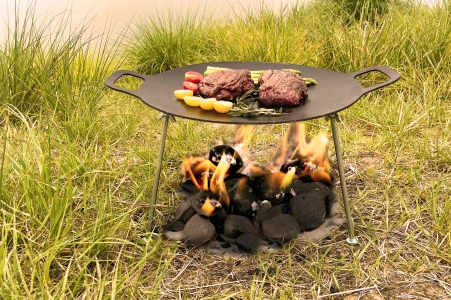
- Place directly on grate or coals (elevate slightly for even heat)
Size & Weight Quick Reference Chart
| Diameter | Cooking Area | Weight Range | Best For | Needs Two Burners? |
|---|---|---|---|---|
| 10.5″ | ~86 sq in | 4–6 lb | 2–3 people, small kitchens | Usually no |
| 12″ | ~113 sq in | 6–8 lb | 4–6 people, most popular | Sometimes |
| 14″ | ~154 sq in | 8–11 lb | 6–10 people, entertaining | Yes |
| 16″ | ~201 sq in | 10–14 lb | Large families, parties | Yes |
Storage & Space-Saving Solutions
- Hang vertically on pot rack (if handles allow)
- Store flat with felt/paper towel protector
- Nest inside larger skillets/Dutch ovens
- Use silicone handle covers to prevent scratching other pans
Care & Cultivation – The Ritual of Respect
A cast iron flat round griddle pan thrives on simple, consistent care.
Cleaning: While warm (not scorching), scrape off food bits. Clean with hot water and a stiff brush or non-abrasive scrubber. Avoid soap to preserve the seasoning. For stubborn residue, use coarse salt as a gentle abrasive.
Drying is Critical: Immediately dry the pan thoroughly with a towel, then place it on a warm burner for a minute to evaporate all residual moisture. This prevents rust.
Seasoning Maintenance: After drying, apply a microscopically thin coat of neutral oil to the cooking surface with a paper towel. The residual heat will help bond it.
Storage: Store in a dry place. If stacking, place a paper towel or cloth between pans to prevent scratches.
Final Thoughts
A good flat round griddle pan is one of the highest “uses per dollar” investments you can make. You get:
- perfect circular heat symmetry
- large usable cooking area
- lifelong durability
- continually improving non-stick performance
- compatibility with every heat source you own
Treat it with respect, feed it a thin layer of oil after each use, and it will reward you with decades of reliable, flavorful cooking.
Ready to add one to your collection? Explore the durable, pre-seasoned flat round griddle pan options at chinacastiron.com today.