Why Is a Dutch Oven So Heavy? The Secrets Behind the Weight
Few pieces of cookware inspire as much love—and occasional complaints—as the Dutch oven. People marvel at its cooking performance, durability, and versatility, yet almost everyone who picks one up for the first time asks the same question:
Why is a Dutch oven so heavy?
The short answer is simple: the weight is not a flaw — it is the single most important feature that makes the Dutch oven one of the greatest cooking tools ever invented. That heaviness is deliberate engineering, not an accident. It is the direct result of material choice, wall thickness, lid design, and thermal physics that give the Dutch oven its legendary heat retention, even cooking, versatility, and longevity.
We uncover the secrets behind the weight of a Dutch oven, explain exactly why that mass matters for both stovetop and open-fire cooking, compare light vs heavy models, explore modern manufacturing choices, and show why high-quality cast iron Dutch ovens from chinacastiron.com strike the perfect balance between performance and manageable weight.
The Physics: Why Heavy = Better in a Dutch Oven
Cast iron Dutch ovens typically weigh 10–25 lbs (4.5–11 kg) empty, depending on size. That’s 3–10× heavier than an equivalent aluminum or stainless pot. The weight comes from:
- High-density material — cast iron density ≈ 7.2 g/cm³ (vs aluminum 2.7 g/cm³, stainless ~7.8 g/cm³ but usually thinner)
- Thick walls & base — 4–7 mm base, 3–5 mm sides (vs 1–3 mm in most modern pots)
- Heavy lid — often 40–50% of total weight, designed to trap heat and steam
This mass creates three critical cooking advantages:
1.1 Exceptional Heat Retention (Thermal Mass)
Specific heat capacity of cast iron ≈ 0.46 J/g·K. A 10 lb (4.5 kg) Dutch oven stores roughly 2,070 J/°C of heat.
When you add cold/wet ingredients (meat, vegetables, stock):
- Thin aluminum pot drops 100–200 °F instantly → long recovery time
- Heavy cast iron drops only 30–60 °F → recovers in seconds
Result: stable simmering, even braising, consistent baking — even over variable campfire heat.
1.2 Superior Heat Distribution & Inertia
Thick cast iron spreads heat evenly across the entire surface. Thin pots create hot spots → burning in the center, undercooking at edges.
The high thermal inertia resists sudden changes:
- Opening the lid to stir or check → minimal temperature loss
- Adding cold liquids → quick rebound to target temp
- Wind gusts or uneven coals → cooking stays consistent
1.3 Radiant Heat & Oven-Like Performance
Heavy lid + thick walls radiate heat inward from all directions → true oven effect when coals are placed on top.
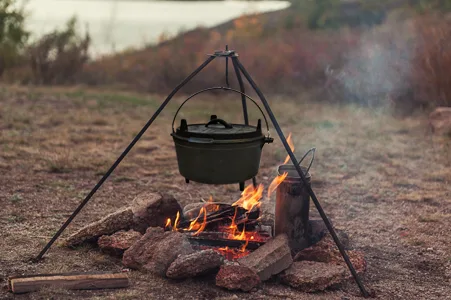
This is why a suspended Dutch oven cooking tripod with a heavy cast iron Dutch oven from chinacastiron.com bakes bread, cobblers, and roasts so much better than thin pots over fire.
Metallurgy: Why Cast Iron is the Chosen Material
Dutch ovens are heavy because they are made of Gray Cast Iron, a material with high carbon and silicon content.
Structural Density
Unlike “stamped” metalware, cast iron is poured into a sand mold. To ensure the molten metal flows correctly without creating air pockets (porosity), the walls must be cast to a specific thickness (usually 3.5mm to 5mm). This thickness, combined with the density of iron ($7.87 g/cm^3$), results in the signature weight.
China Cast Iron utilizes the DISAMATIC molding process to ensure that even though the pot is heavy, the weight is distributed with mathematical precision, preventing “hot spots” that occur in cheaper, uneven castings.
Stability: From the High Power Gas Stove to the Fire Pit
The weight of a Dutch oven provides a level of safety and stability that lighter cookware lacks.
On the Stove: It won’t slide around when you are deglazing a sauce or stirring a thick stew.
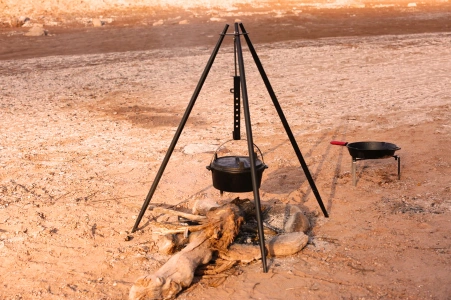
On the Tripod: When suspended from a Dutch oven cooking tripod over a campfire, the weight is essential. A light pot would swing violently in the wind or when stirred. The mass of a China Cast Iron pot keeps the center of gravity low and stable.
Outdoor Gear: Even in specialized outdoor setups like a campfire tripod fire pit, the weight ensures that the pot stays seated in the flames, absorbing heat from all angles.
Weight as a Mark of Quality in 2026
For those in the folding BBQ grill wholesale or retail business, weight is the most reliable “shortcut” for judging quality.
| Feature | Low-Quality “Lite” Iron | China Cast Iron Standard |
| Wall Thickness | < 3mm (Prone to cracking) | 4mm – 5mm (Lifetime durability) |
| Heat Retention | Rapid fluctuations | Steady, even radiation |
| Lid Fit | Gaps/Steam leaks | Precision-weighted seal |
| Compatibility | Warps on high power gas stove | Dimensionally stable |
Managing the Weight: Ergonomics and Tools
While the weight is a benefit for cooking, it requires proper handling.
Dual Handles: Professional Dutch ovens feature “loop” handles that allow for a two-handed grip.
The Tripod Advantage: Using a Dutch oven cooking tripod takes the strain off the cook, allowing the fire to do the heavy lifting.
The Right Accessories: When moving a heavy pot from a portable gas burner to the table, always use high-friction, heat-resistant silicone or leather grips to manage the inertia of the heavy iron.
Conclusion: The Burden of Excellence
A Dutch oven is heavy because it refuses to compromise. Its weight is the physical manifestation of its ability to retain heat, seal in moisture, and last for generations. When you choose a heavy piece of ironware from China Cast Iron, you aren’t just buying a pot; you are buying a 2026 thermal engine that will transform your cooking.
Whether you are searing on a high power gas stove or slow-cooking over a campfire tripod fire pit, remember: the weight is not an obstacle—it is the secret ingredient.
References and Sources
Journal of Thermal Analysis and Calorimetry: Specific Heat Capacity and Thermal Diffusivity of Gray Cast Iron Alloys (2025).
Culinary Engineering Review: The Relationship Between Pot Wall Thickness and Maillard Reaction Consistency.
American Foundry Society: Principles of Sand Casting and Wall Thickness Optimization for Pressure-Seal Cookware.
Modern Gastronomy Institute: Moisture Loss Ratios: Weighted vs. Unweighted Lids in Long-Duration Braising (2026).
China Cast Iron Research & Development: The Impact of Mass Distribution on Induction Efficiency. https://chinacastiron.com/