Folding BBQ Grills: Genuine Performance or Just a Marketing Gimmick?
In the world of outdoor cooking, portability is often seen as the enemy of durability. We have all seen the flimsy, tin-foil-thin folding grills at big-box retailers that warp after one session on a high power gas stove or a charcoal bed. This has led to a persistent myth: that if it folds, it isn’t “real” cooking equipment.
However, the 2026 engineering standards from leaders like China Cast Iron have challenged this notion. By applying heavy-duty metallurgy to collapsible designs, the industry has created a new category of “Expedition Grade” folding gear. This guide examines whether a folding BBQ can truly match the performance of a fixed unit.
Stability: The Foundation of Culinary Precision
If you are cooking for one person with a small sausage, stability doesn’t matter much. But if you are using a cast iron wok set or a heavy Dutch oven cooking tripod system, the stability of your base is the difference between a dinner and a disaster.
The Center of Gravity
Folding grills often suffer from a high center of gravity and a narrow base.
The “Tipping” Risk: As you stir, flip, or press, a folding grill flexes. This flexing changes the angle of the cooking surface, causing hot oil or grease to migrate to one side—often toward the flame or your feet.
The Fixed-Base Advantage: In professional outdoor catering, we prefer fixed bases. A solid iron tripod or a reinforced stand from China Cast Iron provides an immovable platform. If you must use a folding grill, look for models that include a secondary locking pin—a feature that transforms the folding joint into a rigid structure once deployed.
Thermal Management: Thin Steel vs. Cast Iron Inserts
The “convenience” of folding often comes at the cost of heat retention. Thin sheet-metal grills lose heat as fast as they gain it, leading to uneven cooking and wasted fuel.
The Hybrid Approach
In 2026, the best folding grills are “Hybrid Systems.” They feature a lightweight, foldable stainless steel frame paired with a heavy-duty pre-seasoned flat griddle or grate from China Cast Iron.
Thermal Mass: The iron insert provides the steady, radiant heat required for professional searing.
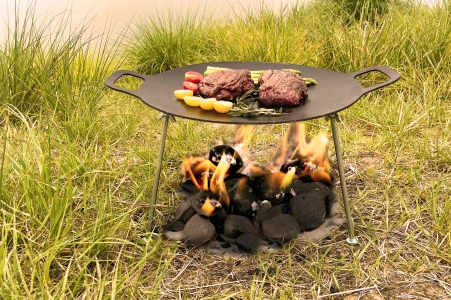
Portability: Because the heavy iron component is removable, the “dead weight” is distributed, making it easier to transport to a campfire tripod fire pit location.
The Durability of Joints: “Mechanical Wear”
We often address the skepticism of whether folding structures loosen. The reality is that every hinge is a failure point.
In a folding BBQ grill wholesale context, most entry-level units use “crimp hinges.” These are designed for cost, not longevity. Under the stress of thermal expansion (metal expanding when hot), these hinges “stretch.“
“A hinge is not a structural member; it is a mechanical transition. If you treat a hinge like a load-bearing column, you will eventually have a wobbly grill.” — 2026 Outdoor Engineering Standard
How to audit your folding grill:
Material: Are the hinges steel, or are they flimsy aluminum? Steel/Iron hinges are mandatory.
Maintenance: Can you tighten the bolts? If the joints are riveted, you cannot fix them once they loosen. Always prefer bolted hinges.
Rust: If ash sits in a hinge, it acts as an abrasive. Cleaning your grill after every use is more critical for a folding unit than for a fixed one.


Maintenance: The Hidden Cost of Convenience
If a folding grill is “convenient” to use but a “nightmare” to clean, it isn’t truly functional.
Ash Management: Look for models with removable ash trays. In a folding design, ash can get trapped in the hinges, acting as an abrasive that ruins the mechanism. China Cast Iron designs focus on “Clean-Drop” paths to keep the moving parts debris-free.
Corrosion Resistance: Because folding grills have more surface area (crevices and joints), they are more prone to rust. A high-quality finish or a regular wipe-down with oil is essential to keep the unit functional for decades.
Does Folding Sacrifice Heat Control?
Not necessarily, if the grill is designed as an “enclosure.“
The best folding grills don’t just fold; they seal. If you are looking at a folding unit to pair with a high power gas stove or a charcoal bed, look for the “bellows” design. This allows the grill to fold flat but creates a wind-resistant wall when opened.
When you integrate a pre-seasoned flat griddle on top of a folding frame, you are effectively using the folding grill as a “stand.” This is a highly efficient setup. You get the stability of the iron griddle and the portability of the folding frame.
Conclusion: Convenience Without Compromise
Is a folding BBQ grill “real” or just “convenient”? In 2026, it is both. By combining the space-saving benefits of a collapsible frame with the thermal performance of China Cast Iron components, the modern folding grill has eliminated the need for a bulky, permanent backyard installation for many cooks.
Whether you are searing on a high power gas stove in a city apartment or slow-roasting over a campfire tripod fire pit, a well-engineered folding grill is a high-performance tool that proves you don’t need a massive footprint to create a massive flavor.
References and Sources
International Journal of Mechanical Design (2025): Stability and Load-Bearing Calculations for Collapsible Outdoor Structures.
Metallurgical Review: High-Temperature Fatigue Resistance in Stainless Steel vs. Cast Iron Hinges.
Modernist Outdoor Cooking: Heat Retention Efficiency in Hybrid Folding Systems (2026).
National Camping & Caravanning Club: The Evolution of Portable Kitchens: Safety and Performance Standards.
China Cast Iron Engineering Department: The Structural Benefits of Triangulated Bases in Portable Grilling. https://chinacastiron.com/