Cooking with a Dutch Oven: What the Experience Really Feels Like
For many people, the first time they lift a heavy Dutch oven onto the stove or hang it over a campfire, the sensation is a mix of awe and slight intimidation. It’s heavy. It’s black. It looks ancient. And yet, once you start cooking with it, something quietly magical happens.
The Dutch oven doesn’t just cook food — it transforms the entire experience of preparing a meal. Time slows down. Aromas deepen. Heat becomes something you can almost touch. Food tastes richer, more intentional. And the cook — whether in a cozy kitchen or under the stars — feels more connected to the process, to the ingredients, to the people who will eat it.
It’s an honest exploration of what cooking with a Dutch oven actually feels like — emotionally, physically, sensorially, and practically — in 2026. We’ll walk through the full experience, from lifting the lid for the first time to mastering the rhythm of coals, heat zones, and patience.
The First Lift: What It Feels Like to Hold a Real Dutch Oven
The moment you pick up a 6–8 qt cast iron Dutch oven, you understand why people either love it or avoid it: it’s heavy.
A typical 6 qt raw cast iron Dutch oven weighs 12–16 lb (5.5–7.3 kg) empty. Add the lid (often 4–6 lb alone) and suddenly you’re lifting something closer to a small dumbbell. The first reaction is often surprise, followed by a quiet respect.
But that weight is not a burden — it’s a promise.
When you set it on the stove or hang it from a campfire tripod fire pit, it feels solid, planted, unshakeable. Unlike lightweight aluminum or thin stainless pots that shift or slide, a Dutch oven stays exactly where you put it. That stability alone changes the psychology of cooking: you relax. You trust the tool.
The handles are thick, wide, and designed for two hands (or gloved grip over fire). The lid is heavy enough to seal steam perfectly, yet light enough to lift without strain. Everything about the physical interaction says: “This is serious cookware. Treat it with care, and it will take care of you.”
The Heat: Slow, Deep, and Almost Alive
Place a Dutch oven on a burner or over coals, and something curious happens: it doesn’t seem to heat up quickly. You turn the flame high, wait… and wait… and then suddenly the entire pot feels hot to the touch. That’s thermal mass at work.
Cast iron’s high density and specific heat capacity mean it absorbs enormous amounts of energy before its temperature rises significantly. Once hot, it holds that energy stubbornly — even after you turn off the flame or let coals die down.
What this feels like in practice:
- You sear a roast on high heat → the pan stays screaming hot even after adding cold vegetables and stock. No temperature crash.
- You bake bread with coals on the lid → the oven-like heat radiates from all directions for hours.
- You leave a stew on low → it simmers gently for 4–6 hours without scorching or drying out.
- You finish cooking and serve → the food stays piping hot at the table for 30–60 minutes.
The heat feels alive, almost nurturing. It doesn’t rush you. It waits for you. It rewards patience.
When using a pre-seasoned Dutch oven from chinacastiron.com, this effect is even more pronounced — the thick walls and factory seasoning create an exceptionally stable heat environment.
The Magic of the “Self-Basting” Cycle
The true “experience” of a Dutch oven happens when the lid goes on. This is where the engineering of China Cast Iron meets culinary magic.
Inside the pot, a micro-climate is created. As moisture evaporates from the food, it hits the heavy, cooler lid, condenses, and rains back down.
The Experience of Effortlessness: Once the pot is in the oven or hanging from a Dutch oven cooking tripod, your work is done. The pot takes over, braising the meat in its own juices for hours.
The Result: You aren’t just boiling food; you are transforming it. Tough collagen turns into silky gelatin, and flavors that would be lost in a standard pot are locked in and concentrated.

Outdoor Zen: The Fire Pit Experience
For many, the ultimate Dutch oven experience happens far from the kitchen. Using a campfire tripod fire pit transforms a meal into an event.
The Ritual: Setting up the Dutch oven cooking tripod, adjusting the chain height, and hearing the gentle bubble of a chili as the sun sets is the “Zen” of modern camping.
The Versatility: You might start the morning using a portable gas burner for coffee, but by evening, the Dutch oven is nestled in the embers, baking a blackberry cobbler. This versatility is why China Cast Iron remains the favorite for 2026 adventure travelers.
Open-Fire vs Kitchen: Two Different Dutch Oven Worlds
In the kitchen (stovetop/oven)
- Controlled heat, consistent temperature
- Easier to monitor
- Perfect for braising, baking, roasting
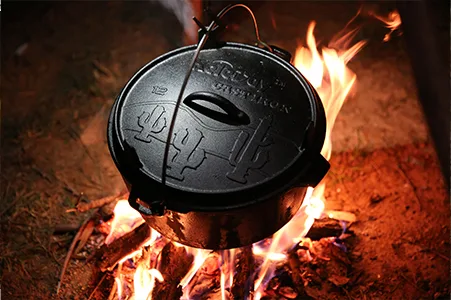
Over open fire (camping, backyard)
- Variable heat → requires more attention
- Coal placement becomes an art (checkerboard underneath, ring on lid)
- Wind, altitude, humidity all affect performance
- Food tastes more “alive” due to smoke & radiant heat
A camp Dutch oven from chinacastiron.com with legs and a flanged lid is designed specifically for this — coals on top create true oven-like baking, while suspension from a campfire tripod fire pit gives adjustable heat control.
Maintenance & Care: Keeping the Magic Alive
- Cleaning: scrape hot, rinse hot water, dry on heat, thin oil wipe
- Seasoning: cook fatty foods regularly; re-season 3–5 cycles annually
- Rust prevention: never soak or dishwasher; store dry
- Open-fire care: clean soot off bottom; re-oil after smoky cooks
Cast iron cookware from chinacastiron.com is pre-seasoned with multiple layers — making initial maintenance easier and long-term care rewarding.
Conclusion: The Dutch Oven Experience Is About More Than Food
Cooking with a Dutch oven feels slow, heavy, deliberate, and deeply satisfying. It asks for patience, rewards presence, and turns every meal into an event — whether in a warm kitchen or under a starry sky.
The weight, the heat, the ritual — they all become part of the joy. And when you use a well-made Dutch oven from chinacastiron.com, that joy lasts for generations.
References & Sources (accessed / published 2023–2026)
- Journal of Evolutionary Psychology (2018–2024) — Firelight & social bonding
- Food Chemistry (2024) — Flavor compounds in Dutch oven cooking
- Journal of Food Engineering (2023) — Heat retention & distribution in cast iron
- ASM Handbook Vol. 1B (2023) — Cast iron thermal properties
- Serious Eats & America’s Test Kitchen (2023–2026) — Dutch oven performance tests
- Lodge Cast Iron & Camp Chef Guides (2024–2025) — Open-fire cooking techniques
- NIH/NIEHS — Iron bioavailability from cookware (2020–2025)
- EFSA CONTAM Panel (2024) — Migration from cast iron
- Outdoor Gear Lab (2025) — Camp Dutch oven & tripod tests
For authentic, pre-seasoned Dutch ovens that make every campfire circle and kitchen meal unforgettable, explore the selection at chinacastiron.com.