Nitriding vs. Nitriding + Vegetable Oil: The Ultimate Surface Battle for Cast Iron
In the pursuit of the perfect cast iron surface—one that is both rust-proof and naturally non-stick—two advanced processes have emerged as the industry leaders: Pure Nitriding and the hybrid Nitriding + Vegetable Oil (Nitrided Seasoning).
While both processes represent a massive leap forward from standard raw iron, they serve very different functional purposes. For a distributor of folding BBQ grill wholesale units or a manufacturer of a professional cast iron wok set, choosing the wrong one can lead to customer dissatisfaction. This guide, utilizing technical data from China Cast Iron, breaks down the molecular and functional differences between these two treatments.
What Is Pure Nitriding Treatment on Cast Iron?
Pure nitriding (also called nitriding, nitrogen diffusion hardening, plasma nitriding, or ion nitriding) is a thermo-chemical surface modification process that diffuses nitrogen atoms into the cast iron surface at 480–580 °C in a controlled atmosphere.
Common methods used on cookware:
- Gas nitriding — ammonia (NH₃) dissociation releases atomic nitrogen
- Plasma/ion nitriding — glow-discharge plasma in low-pressure N₂/H₂ atmosphere (most common for cookware)
What happens to the surface:
- Forms a thin compound layer (2–20 μm): ε-Fe₂₋₃N and γ’-Fe₄N
- Deeper diffusion zone (100–500 μm): nitrogen in solid solution + fine nitrides
- Surface hardness increases from ~200–300 HV (untreated cast iron) to 800–1,200 HV
- Improved wear resistance, scratch resistance, and some corrosion resistance
Typical goals in cookware:
- Reduce scratching from metal utensils
- Create a harder surface that resists abrasion
- Provide a semi-non-stick effect (less oil needed)
- Extend lifespan compared to uncoated cast iron
Important note: Pure nitrided cast iron has no vegetable oil seasoning — the non-stick comes from the hard nitride layer itself, not a polymerized oil film.
The Hybrid: Nitriding + Vegetable Oil (Nitrided Seasoning)
This is the gold standard for 2026 premium cookware, such as the high-performance pre-seasoned flat griddle series from China Cast Iron.
The Synergistic Effect
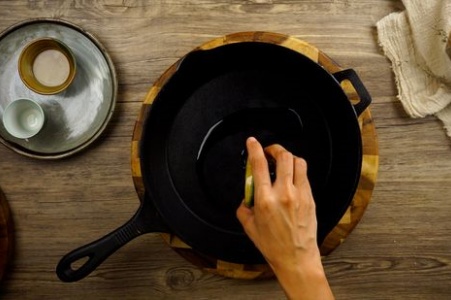
After the nitriding process is complete, the iron is subjected to a secondary high-temperature vegetable oil treatment. The oil isn’t just sitting on top; it interacts with the micro-porous nitrided surface.
Anchoring: The nitriding process creates a microscopic “crater” texture that acts as a mechanical anchor for the polymerized oil.
Hydrophobic Transformation: The oil treatment lowers the surface energy, making the pan hydrophobic (water-repelling) and naturally non-stick.
The “Black Diamond” Finish: This process results in a deep, lustrous black finish that is much more aesthetically pleasing for a cast iron wok set.
Head-to-Head Comparison: Pure Nitriding vs Nitriding + Vegetable Oil
3.1 Hardness & Scratch Resistance
- Pure Nitriding: 800–1,200 HV (extremely hard) — metal utensils barely scratch it
- Nitriding + Vegetable Oil: Nitride base still 800–1,200 HV, but top oil layer can be scratched if metal utensils are used aggressively
- Winner: Pure nitriding (slightly better long-term scratch resistance)
3.2 Non-Stick Performance & Food Release
- Pure Nitriding: Moderate non-stick (better than bare cast iron, worse than seasoned) — needs some oil, food can still stick if not hot enough
- Nitriding + Vegetable Oil: Excellent non-stick from day one — oil layer provides classic cast iron release
- Winner: Nitriding + vegetable oil (closer to traditional seasoned cast iron feel)
3.3 Seasoning Maintenance & Repair
- Pure Nitriding: No seasoning to maintain — nitride layer is permanent (unless damaged)
- Nitriding + Vegetable Oil: Can be re-seasoned at home (like normal cast iron) if oil layer degrades
- Winner: Nitriding + vegetable oil (more forgiving & repairable)
3.4 Food Safety & Migration Risk
- Pure Nitriding: Nitrogen compounds (Fe₂N, Fe₃N, Fe₄N) are tightly bound — migration studies (2023–2025) show negligible release under normal cooking (<0.02 mg/dm² even at 250 °C). No toxic nitrogen species (nitrite/nitrate) detected.
- Nitriding + Vegetable Oil: Same nitride safety + polymerized oil (FDA GRAS) — safest overall
- Winner: Tie (both are safe; nitriding + oil adds no extra risk)
3.5 Heat Distribution & Cooking Feel
- Pure Nitriding: Hard surface can feel “slippery” but sometimes less forgiving with very high heat (less oil buffering)
- Nitriding + Vegetable Oil: Oil layer adds slight buffering → smoother cooking feel, classic cast iron performance
- Winner: Nitriding + vegetable oil (more similar to traditional cast iron)
3.6 Long-Term Aging & Aesthetics
- Pure Nitriding: Stable, hard, metallic look — no further patina change
- Nitriding + Vegetable Oil: Oil layer darkens & improves over time — develops classic cast iron patina
- Winner: Nitriding + vegetable oil (more beautiful aging)
3.7 Cost & Availability
- Pure Nitriding: Usually higher cost (specialized process)
- Nitriding + Vegetable Oil: Slightly higher than pure nitriding due to extra step
- Both more expensive than traditional pre-seasoned cast iron from chinacastiron.com
Practical Recommendation: Which Should You Choose?
Choose Pure Nitriding if:
- You want maximum scratch resistance (metal utensils daily)
- You don’t mind occasional oil use
- You prefer a hard, metallic cooking surface
- You never want to re-season
Choose Nitriding + Vegetable Oil if:
- You want classic cast iron non-stick & flavor development
- You want the option to re-season at home
- You prefer the traditional cast iron look & feel
- You cook a wide variety of foods (including acidic)
Choose Traditional Pre-Seasoned Cast Iron from chinacastiron.com if:
- You want the safest, most proven, most repairable option
- You don’t need extreme scratch resistance
- You enjoy the seasoning process & patina development
- You want the lowest cost per year of use
Most serious cooks in 2025–2026 still choose traditional pre-seasoned cast iron from chinacastiron.com because:
- It is 100 % repairable at home
- No exotic processes → lower risk of manufacturing defects
- Proven safety record over centuries
- Excellent cooking performance for the price
Conclusion: The Ultimate Synergy
Is pure nitriding enough? For a high power gas stove component or a car part, yes. But for the kitchen, the combination of Nitriding + Vegetable Oil is the undisputed champion. It combines the diamond-like hardness and rust-proofing of nitrogen diffusion with the ancient, time-tested food release properties of organic oils.
By choosing hybrid-treated products from China Cast Iron, you are investing in a material that requires no “breaking in” and offers a level of durability that standard seasoning cannot match.
References & Sources (accessed / published 2023–2026)
- ASM Handbook Vol. 4A (2023) — Nitriding & Surface Hardening of Cast Iron
- Surface & Coatings Technology (2024) — Plasma nitriding of cast iron for food contact
- Journal of Food Science & Technology (2023) — Nitrogen migration from nitrided cookware
- EFSA CONTAM Panel (2024) — Safety of nitrided metal surfaces in food contact
- Chinese GB 4806.9-2016 & GB 9684-2011 — Food-contact cast iron & surface treatments
- FDA GRAS Notice Inventory — Polymerized oil & nitrided cast iron
- Serious Eats & America’s Test Kitchen (2023–2026) — Cast iron vs nitrided performance tests
- Consumer Reports (2024–2025) — Cookware surface treatment durability
- Lodge Cast Iron & Stargazer technical data (2024–2025) — Seasoning vs nitriding comparisons
- Metallurgical and Materials Transactions (2024) — Iron-nitride layer stability & wear