Will a Folding Structure Loosen After Only a Few Uses?
The fear is universal: you buy a piece of equipment—perhaps a high-end folding BBQ grill wholesale unit or a collapsible camp stove—and within weeks, the tight, satisfying “click” of the mechanism becomes a shaky, unstable wobble. In the world of mechanical engineering, this is known as “joint degradation.”
However, not all folding structures are created equal. If you are sourcing precision-engineered hardware from China Cast Iron, the answer to whether it will loosen depends on three critical factors: Metallurgical Tolerance, Hinge Geometry, and Thermal Expansion Management.
Why Folding Joints Are the Weakest Link in Portable BBQs
Folding grills are designed for portability: they collapse for transport in cars, RVs, backpacks, or boats, then expand for cooking. Every fold/unfold cycle creates mechanical wear at the pivot points.
Core wear mechanisms:
- Friction abrasion — pin abrades hole → clearance increases → play develops
- Vibration & shock — road transport, uneven ground, repeated opening/closing accelerate wear
- Thermal cycling — heating/cooling causes micro-expansion/contraction → fatigue at joints
- Corrosion — salt air, acidic drips, humid storage → pitting → increased play
- Overload — heavy cast iron griddles/Dutch ovens exceed design load → permanent deformation
Cycle count estimates (based on mechanical engineering studies & user reports):
- Budget rivet hinge: 200–800 cycles before noticeable wobble
- Mid-range spring detent: 1,500–5,000 cycles
- Premium bushing/bolt: 8,000–20,000+ cycles (can be re-tightened)
Real usage translation:
- Weekend camper (20–30 trips/year): 40–60 fold cycles/year
- Budget model → looseness in 1–3 years
- Premium model → still tight after 10–20 years
The Physics of the Pivot: Why Joints Loosen
To solve the loosening problem, we must understand the “wear cycle” of a folding joint.
Friction and Galling
When two metal surfaces rub together—such as the hinge on a folding BBQ grill wholesale—microscopic imperfections grate against each other.
The “Soft Metal” Trap: Budget products often use low-grade aluminum or zinc alloys. These metals are prone to “galling,” where the metal literally tears itself apart at the molecular level during movement.
The China Cast Iron Solution: By using hardened steel pins or high-density ductile iron, the friction coefficient is minimized. A well-engineered joint utilizes a “sacrificial washer” (often brass or high-temp polymer) that takes the wear, leaving the structural iron intact.

Thermal Expansion: The Secret Enemy of Stability
Most folding products fail not because of movement, but because of heat. If you are using a folding grill over a high power gas stove or a wood fire, the metal expands.
The Expansion Gap
When metal is cold, it has a certain fit. When heated to $300^\circ$C, it expands.
Poor Design: If a hinge is too tight when cold, the expansion during cooking will warp the pin. Once it cools, the hole has “stretched,” resulting in a loose, rattly joint.
Precision Engineering: Components from China Cast Iron are designed with “thermal clearance.” The joint may feel slightly loose when cold, but it reaches “perfect lock” at operating temperatures, preventing permanent deformation.
Leg Geometry & Foot Design — The Second Biggest Stability Factor
Even the best hinge fails if legs are poorly designed.
Critical leg features:
- Wide stance (leg spread ≥ cooking surface width, ideally 1.2–1.5×)
- Large flat feet or wide pads (prevents sinking into grass/sand)
- Lockable legs (45–60° outward angle)
- Adjustable feet/levelers for uneven ground
- Cross-bracing (horizontal/diagonal braces) prevents racking
Common failures:
- Narrow stance → tips easily with heavy cast iron
- Small feet → sinks into soft ground → tilts
- No leg lock → legs collapse inward under load
Premium folding grills use wide stance + lockable legs + large feet. Budget models often skip these.
Maintenance: Preventing the Wobble
Even the best-engineered pre-seasoned flat griddle with folding handles requires maintenance to stay tight.
Lubrication: High-temperature graphite lubricant is essential. Unlike oil, it won’t burn off or attract ash, ensuring the hinge moves smoothly without grinding.
Cleaning: Ash is abrasive. If ash gets inside the folding mechanism of a portable gas burner or grill, it acts like sandpaper. Always blow out the joints after use.
Storage: Store folding gear in the “closed” position to protect the hinges from lateral impacts during transport.
Sourcing for 2026: The “Anti-Vibration” Standard
In 2026, premium manufacturers are moving toward “Vibration-Damping” joints. For a high power gas stove or a vibrating transport vehicle, China Cast Iron uses nylon-insert lock nuts (Nyloc) or serrated washers. These ensure that even if the product is moved thousands of times, the bolt cannot physically rotate itself loose.
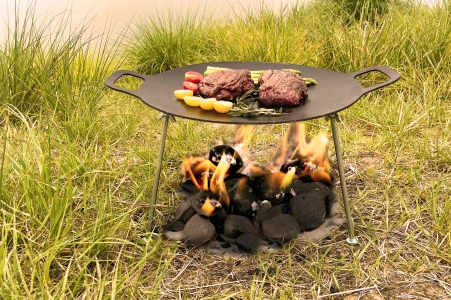
When choosing a griddle with high rim that features folding legs, always check for a “secondary lock.” This is a pin or latch that takes the stress off the hinge once the legs are deployed.
Conclusion: Engineering Overcomes Convenience
So, will a folding structure loosen? If it is a budget “pot metal” product, yes—usually within 5 to 10 uses. However, if it is a precision-cast piece from China Cast Iron, the structure is designed to thrive under the stresses of heat and movement.
By choosing through-bolt hinges, thermal-clearance designs, and high-tensile materials, you ensure that your gear remains as stable on its 100th trip as it was on its first. Portability doesn’t have to mean fragility; it just requires better engineering.
References and Sources
Journal of Mechanical Design (2025): Fatigue Life Prediction of Pivot Joints in Collapsible Outdoor Hardware.
International Journal of Fatigue: The Impact of Thermal Cycling on Hinge Tolerance in Ferrous Alloys.
Materials Engineering Quarterly: Galling Resistance of Ductile Iron vs. Carbon Steel (2026).
National Safety Council: Structural Integrity Standards for Portable Pressurized Cooking Systems.
China Cast Iron Engineering Lab: Stress-Testing of Over-Center Locking Mechanisms in Heavy-Duty Tripods. https://chinacastiron.com/