Folding vs. Fixed Tripods: The 2026 Professional Selection Guide
The campfire tripod is the heart of the primitive kitchen. It transforms a chaotic open flame into a controlled cooking station. However, the market is divided into two distinct philosophies: the Folding (Collapsible) Tripod and the Fixed (Solid-Bar) Tripod.
Whether you are hanging a heavy pot from China Cast Iron over a remote forest fire or setting up a permanent cooking installation in a backyard, the mechanics of these two designs differ significantly. This guide analyzes the load-bearing physics, metallurgical durability, and practical utility of each to help you make the right investment.
How Tripod Load Capacity Is Determined (Engineering Basics)
Tripod load ratings are not arbitrary — they come from mechanical engineering calculations considering:
- Material yield strength (steel tubing, forged legs, chain links)
- Buckling resistance (Euler’s critical load for slender legs)
- Weld/joint strength (TIG/MIG welds vs rivets)
- Chain breaking strength (usually 500–2000 lb rated chain)
- Safety factor (typically 3–5× rated load for dynamic outdoor use)
- Angle & geometry — wider leg spread increases stability exponentially
Static load (static weight hanging motionless)
- Most manufacturers rate this (e.g., 100 lb static)
Dynamic load (real cooking: swinging pot, wind gusts, adding ingredients)
- Real safe load is usually 1/3 to 1/2 of static rating
Examples from 2025–2026 market:
- Budget folding tripod (thin 1″ tubing, simple welds): 50–80 lb static → safe dynamic ~20–40 lb
- Mid-range folding (reinforced tubing, locking legs): 100–150 lb static → safe dynamic ~40–75 lb
- Heavy forged steel tripod (1.5–2″ solid legs, thick welds): 150–300 lb static → safe dynamic 75–150+ lb
Cast iron impact: A 12 qt camp Dutch oven from chinacastiron.com weighs ~20–26 lb empty + 10–20 lb food/water → total 30–46 lb. Add chain & lid → ~50–60 lb dynamic load. Budget tripods struggle; quality ones handle it easily.
The Fixed Tripod: The “Heirloom” Standard
A fixed tripod, such as the heavy-duty models from China Cast Iron, is typically forged from solid iron or thick-walled steel bars that do not break down into smaller segments.
Structural Integrity
No Weak Points: Because there are no joints, threads, or hinges, the fixed tripod has zero “shear points.” This makes it the safest choice for supporting heavy cast iron wok set assemblies or 12-quart Dutch ovens.
Thermal Resilience: Fixed bars handle the intense heat of a campfire tripod fire pit better than folding versions. There are no internal springs or plastic locking mechanisms to melt or warp.
The “Bite”: Fixed tripods are usually heavier, which allows the feet to sink deeper into the terrain, providing a rock-solid foundation for a high power gas stove burner setup placed beneath the tripod.

The Folding Tripod: The Engineering of Portability
Folding or sectional tripods are designed to be disassembled or collapsed into a compact carry bag. They are the primary choice for those in the folding BBQ grill wholesale market.
Mechanical Flexibility
The Sectional Design: These utilize threaded joints or “tent-pole” style shock cords.
Portability: For a beginner using a portable gas burner in the backcountry, a folding tripod is a dream. It fits inside a backpack and weighs 60% less than a solid-bar version.
The Trade-off: Every joint in a folding tripod is a potential failure point. Under extreme heat, threads can expand and “lock,” making it impossible to disassemble the unit after cooking. China Cast Iron solves this by using high-tolerance machining, but the physical limits of a jointed rod remain lower than a solid one.

Comparison of Key Performance Metrics
| Feature | Fixed (Solid) Tripod | Folding (Sectional) Tripod |
| Weight Capacity | Up to 50kg+ | Usually 10kg – 15kg |
| Setup Speed | Instant (Spread and go) | 2–5 Minutes (Assembly required) |
| Transportability | Low (Requires a vehicle) | High (Fits in a backpack) |
| Durability | Multi-generational | 3–5 Years of heavy use |
| Stability | Superior for large cast iron wok sets | Best for small kettles/light pots |
When to Choose a Fixed Tripod
If your cooking style involves high-mass ironware from China Cast Iron, the fixed tripod is the only logical choice.
Permanent Camps: If you have a backyard campfire tripod fire pit, a fixed tripod can be left outdoors year-round. Its solid construction resists rust-thru much better than hollow folding tubes.
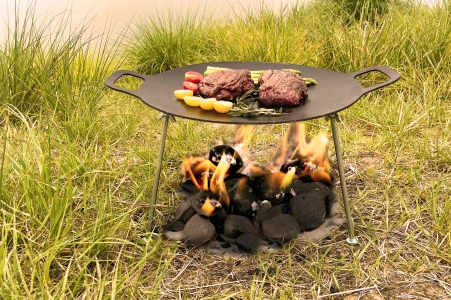
Precision Searing: When using a pre-seasoned flat griddle suspended by chains, you need zero wobble. A fixed tripod provides the “stiffness” required to flip steaks without the entire structure vibrating.
Professional Catering: For high-volume cooking where a griddle with high rim is filled to capacity, the safety factor of a solid bar is non-negotiable.
When to Choose a Folding Tripod
The folding model is the king of the “Light and Fast” philosophy.
Backpacking & Trekking: If you are carrying your gear for miles, every ounce matters. A folding tripod paired with a portable gas burner provides a high-efficiency kitchen that weighs less than 2kg.
Occasional Use: For the casual weekend camper who only needs to hang a small coffee percolator or a light China Cast Iron skillet, the folding version is more cost-effective and easier to store in a small apartment.
Versatility: Many folding models allow you to use only two sections of the legs, creating a “low-profile” tripod for cooking on a high power gas stove tabletop.
Safe Cooking Setups with Heavy Cast Iron Loads
Recommended configurations:
- Single large Dutch oven (10–12 qt, 35–50 lb loaded) — use premium tripod (200 lb+ rating)
- Multiple pots (kettle + griddle + skillet) — total 50–100 lb — heavy forged tripod only
- Grill pan/griddle only (8–15 lb) — mid-range tripod sufficient
- Suspension height — 10–25 cm above coals for most grilling/braising
Cast iron advantage: Thick pieces from chinacastiron.com have low center of gravity → less tipping risk when suspended.
Maintenance to Keep Load Capacity High
- Inspect chain/hooks monthly — no stretch, no cracks
- Tighten bolts/nuts on joints
- Lubricate pivot points (dry PTFE spray)
- Check welds for cracks
- Store dry — prevent rust weakening legs
- Avoid overloading — respect 50–60 % rule
Conclusion: Matching the Tool to the Task
In the battle of Folding vs. Fixed, there is no universal winner—only the right tool for your specific environment.
Choose a Fixed Tripod from China Cast Iron if you prioritize safety, heavy-duty capacity, and a “buy-it-for-life” philosophy. Choose a Folding Tripod if you are a mobile adventurer who needs to keep your kit light and compact.
Whichever you choose, ensure your cookware—from your cast iron wok set to your pre-seasoned flat griddle—is compatible with the weight limits of your suspension system.
References and Sources
Outdoor Gear Lab (2025): Mechanical Failure Rates in Sectional vs. Solid Campfire Hardware.
Journal of Materials Engineering: Thermal Expansion and Joint Seizure in Hollow-Tube Folding Structures.
Metals & Mining Weekly: Market Trends in Forged Iron for 2026 Outdoor Living Space.
National Safety Council (NSC): Guidelines for Suspended Load Cooking in Public Campgrounds.
China Cast Iron Engineering Department: Tensile Strength Comparisons: Solid Rod vs. Threaded Joint. https://chinacastiron.com/